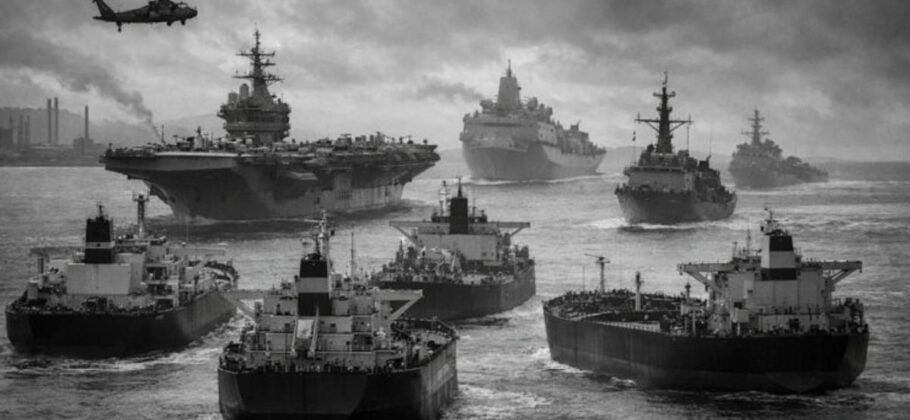
Four oil tankers that tried to slip out of Venezuela with their tracking systems turned off have now turned around and come back. Their return comes as U.S. warships patrol the region, U.S. forces seize vessels, and President Trump moves to take control of Venezuela’s oil system after the capture of Nicolás Maduro.
To many in the shipping and energy world, these tankers look like the last of the old black market trade. They left hoping to run the blockade. They came back because the blockade is now real.
A risky escape that did not work
In early January, about a dozen oil tankers loaded with Venezuelan crude slipped out of the country in what shipping experts call dark mode. Their transponders were switched off to avoid being tracked as they tried to escape a U.S. embargo that began in mid December and pushed Venezuelan exports close to zero.
According to PDVSA and TankerTrackers.com, at least four of those ships have now returned to Venezuelan waters. Reuters later reported that as many as six of the dark mode vessels have come back.
Among the ships that returned are the Panama flagged Merope, the Cook Islands flagged Min Hang, and the Panama flagged Thalia III. Satellite images confirmed their presence back in Venezuelan waters after days of trying to evade the U.S. blockade.
These ships were not empty. Most of them were loaded with crude oil that was supposed to be sold outside the U.S. system.
U.S. warships send a clear message
The turning point came when U.S. forces began intercepting the tankers.
One of the largest ships in the group, the Panama flagged supertanker M Sophia, was seized by U.S. forces this week and sent to U.S. waters. Another ship, the Aframax tanker Olina, flagged by Sao Tome and Principe and previously known as Minerva M, was seized in a predawn raid by U.S. Marines and Navy forces before being released back to Venezuela.
U.S. Southern Command made clear that these operations were backed by the full force of the U.S. Navy, including the USS Iwo Jima, USS San Antonio, and USS Fort Lauderdale. The mission, called Operation Southern Spear, was described as a campaign to end illicit activity and restore security in the Western Hemisphere.
The Olina had already been sanctioned by the United States for carrying Russian oil, which meant its involvement in Venezuela’s shadow trade put it directly in U.S. crosshairs.
To tanker captains watching these seizures in real time, the message was simple. If you keep going, you will be caught.
Trump moves to take over Venezuela’s oil flow
While the tankers were being intercepted at sea, President Trump was making his next move on land.
On Friday, Trump hosted nearly two dozen top oil executives at the White House. Companies like Chevron, Exxon, Shell, ConocoPhillips, Marathon, Valero, Vitol, Trafigura, and Repsol were in the room.
Trump told them they now have total safety and total security in Venezuela. He said they no longer need to deal with the old Venezuelan government. They would deal directly with the United States.
He also announced that Venezuela would turn over between 30 million and 50 million barrels of high quality oil to the U.S. and that it would be sold at market prices, with the proceeds controlled to benefit both Venezuela and the United States.
At the same time, U.S. authorities confirmed that after the capture and removal of Maduro, Venezuela is now under strict U.S. supervision. The next phase will be organized crude exports under a $2 billion oil supply deal being negotiated between Caracas and Washington.
Trading giants Vitol and Trafigura have already received U.S. licenses to handle Venezuelan exports and to supply naphtha to restart operations.
Why the tankers turned back
The ships that fled in dark mode were part of the last attempt to move oil outside U.S. control.
With U.S. warships seizing vessels and satellite tracking making it impossible to hide, tanker owners and captains had to make a choice. Continue running and risk losing everything, or turn back and fall under the new system.
They chose to come back.
The fact that multiple ships from different flags returned almost at the same time suggests coordination and resignation. These crews know the old smuggling routes are finished. Trump now controls who can move Venezuelan oil and who cannot.
What this means for the oil market
The return of these tankers also means that a large volume of crude has been pulled back into Trump’s system.
While exact barrel counts were not released for the returning ships, most of them were loaded, and a supertanker like the M Sophia alone can carry millions of barrels. Combined with Trump’s stated 30 million to 50 million barrel transfer to the U.S., the value of this oil easily runs into billions of dollars at market prices.
By shutting down illicit exports and forcing tankers back under U.S. supervision, Trump is tightening supply while also redirecting Venezuelan oil into a controlled channel. That gives Washington direct influence over how much oil reaches the market and who gets it.
For traders, this reduces the wild card of black market Venezuelan barrels and replaces it with structured, licensed exports through firms like Vitol and Trafigura. That kind of control tends to stabilize prices while shifting profits away from smugglers and into the official system.
A clear signal of who is in charge
To supporters of Trump’s strategy, the returning tankers are proof that the shadow oil trade is finished.
Ships that tried to flee quietly with transponders off were tracked, intercepted, and forced back. One was seized. Another was raided at sea. The rest turned around.
At the same time, Trump was in Washington telling oil executives that Venezuela is now open for business under U.S. control.
In the eyes of the shipping world, that combination of military force and financial authority leaves little doubt. The era of illicit Venezuelan oil exports is ending, and a new system under Trump is taking its place.