The United States did not wake up one morning and decide to hand a major underground industry to foreign networks. But that is what a growing number of narcotics experts, state investigators, and members of Congress now fear is happening. They say Chinese organized crime groups, often described as syndicates or triads, have surged into the American marijuana black market, using the cover of legalization, weak enforcement, and sophisticated financial pipelines to build a sprawling operation that stretches across state lines and, in some cases, across oceans.
Some officials go further. They argue that the pattern is too organized, too well financed, and too strategically placed to be happening without the awareness of Beijing. As Heritage Foundation legal expert Paul Larkin put it, China is “the most heavily surveilled nation in the world,” and he said it is “difficult to believe” the Chinese Communist Party is unaware of what Chinese criminal networks are doing abroad.
At the same time, federal authorities have been cautious about what they can prove publicly. FBI Director Christopher Wray said this year his agency is seeing “more ties between a lot of these growing operations and Chinese organized crime,” but it “hasn’t yet found any direct links” to the Chinese government.
That gap between suspicion and proof is now the center of a fast escalating national debate.
Rob Roggeveen, the national deputy coordinator of the Marijuana Impact Group within the High Intensity Drug Trafficking Areas program, says Chinese organized crime has taken over an estimated 75 percent of the marijuana black market in the United States. He describes the scale in staggering terms, calling the trade an estimated $300 billion a year industry and saying it has grown exponentially.
What makes the story more alarming, he argues, is that this is not just weed being grown locally and sold locally. “This stuff is being exported out of the country,” Roggeveen said, “whether it’s to Canada, France, England. It’s an international business for them.”
In his view, the rise of Chinese syndicates is not a small shift in who sells drugs on a corner. It is a takeover of supply, distribution, and profit. “A decade ago, you rarely saw anything other than the Mexican cartels running marijuana,” he said. “Somewhere along the line, it changed, and that trade changed hands from the Mexican cartels to the CCP.”
That last line is not a courtroom finding. It is an investigator describing what he believes the trend points to.
Why legalization did not kill the black market
Legalization was pitched as the solution that would drain illegal marijuana by giving consumers a regulated alternative. In several states, officials say the opposite happened.
Roggeveen says cartels and syndicates saw legalization as camouflage. Instead of hiding grows on remote public lands the way Mexican cartels once did, he says Chinese groups moved “brazenly” into states that legalized medical and recreational marijuana and reduced penalties for illegal cultivation. In those states, marijuana enforcement was often deprioritized, prosecutors often declined cases, and penalties dropped. “They’re getting absolutely crushed,” Roggeveen said of states trying to keep up.
The CNN reporting from California points to the same dynamic. Siskiyou County Sheriff Jeremiah LaRue described California’s enforcement problem bluntly: “You can have seven plants or 70,000 plants and it still is that same misdemeanor violation. It’s actually just a joke.”
San Bernardino County Sheriff Shannon Dicus framed it as a cold calculation: “It’s risk versus reward. Very small risk, very high reward.”
When the punishment is light and the profits are huge, the black market does not disappear. It professionalizes.
Follow the money: laundering, WeChat, crypto, and alliances
One reason officials believe Chinese syndicates can expand so quickly is money movement.
Christopher Urben, a former DEA agent now working for global investigations firm Nardello and Co., told a House Homeland Security subcommittee that the Chinese Communist Party is now doing most of the money laundering for Mexican cartels and is using WeChat and cryptocurrency to do it.
The Treasury Department’s National Money Laundering Risk Assessment is cited as saying Chinese money laundering organizations are “one of the key actors laundering money professionally in the United States and around the globe.”
Roggeveen says the lack of open warfare between Chinese and Mexican groups raises hard questions. “We don’t see them warring amongst each other over the marijuana trade,” he said. “There’s a lot of theories out there, but the bottom line is they’re operating together.”
Witnesses at the House hearing suggested a possible explanation: Chinese money laundering services for Mexican cartels, a kind of backroom business deal that keeps the cash flowing and the violence lower than expected.
The national security fear: grows near critical infrastructure
For some officials, this is no longer just a drug story. It is an internal security story.
Oklahoma Bureau of Narcotics Director Donnie Anderson testified that some illegal grow operations are located near “critical infrastructure, including military bases and pipelines.” Then he made a claim that pushes the issue into national security territory: “It is my belief that the CCP maintains access to these sites,” he said, pointing to China’s known pressure tactics on expatriates through so called “police stations.”
Anderson also described how Chinese operated grows allegedly evade state requirements. Although Oklahoma requires marijuana business owners to be state residents for two years, he said nearly all Chinese operated grows “circumvent this requirement through fraud and straw ownership,” helped by consulting firms, real estate agents, and attorneys who build shell operations.
He said investigators documented financial transfers to the Bank of China and connections to businesses owned by the Chinese regime.
This is where the tone of “invasion” comes from for many critics: a foreign linked network that buys land, upgrades power, exploits workers, launders money, and sometimes operates near strategic assets.
Three major flashpoints: California, Oklahoma, and Maine
California: Antioch and the “whack a mole” grow house economy
Antioch, California, is described by investigators as a hub for high yield indoor grow houses hidden in normal suburban neighborhoods. Cannabis Control officers raided homes, seized large loads of weed, and still made few arrests. The CNN report described raids where dump trucks were filled with illicit marijuana, yet participants were seldom held accountable.
Officials said the operations show sophistication: fortified doors, boarded windows, ducting, generators, and high end modifications designed for one purpose, mass cultivation. Bill Jones, chief of law enforcement at the California Department of Cannabis Control, said Chinese national criminal networks have become the dominant presence in the state’s illegal cannabis trade over the past five years, eclipsing Mexican cartels.
The CNN report also described how California’s weak penalties keep the cycle running. Homes are raided, repaired, and sold again. A real estate agent involved with multiple raided properties told CNN, “We pay the fine. There is no problem.”
In other words, for some operators, enforcement becomes just another cost of doing business.
Oklahoma: the perfect storm and the export pipeline
Oklahoma legalized medical marijuana in 2018, and officials say it quickly became a main hub of the black market. Mark Woodward, spokesman for the Oklahoma Bureau of Narcotics, said that at the peak, about 85 percent of black market farms were linked to Chinese organized crime.
He explained why it happened. Oklahoma stayed open during the COVID period, while states like California were locked down. The state had cheap land, low priced licenses, and lax laws. “It was just a perfect storm,” Woodward said.
The alleged fraud went deep. Woodward said lawyers and brokers helped connect illegal growers with straw owners to obtain licenses, creating “ghost owners” who appeared on paperwork while the operation was controlled by Chinese nationals. He gave a striking example: in one case, the same person was listed as the owner of nearly 300 farms.
The trafficking numbers are just as dramatic. The Oklahoma Bureau of Narcotics stopped a semitruck in 2023 hauling 7,000 pounds of black market marijuana valued at $28 million, bound for New Jersey and New York. Woodward said that between 2021 and 2024, multiple semis were likely leaving the Oklahoma City area every night.
He also pointed to a huge discrepancy in the state’s tracking system: about 87 million pounds of marijuana were recorded as grown in one period, but only about 1.9 million pounds were documented as sold. “That means there were over 85 million pounds unaccounted for,” he said, “and we knew that was untaxed black market marijuana.”
And the profit motive is obvious. “We’ve had some black market growers in Oklahoma say they can grow for as little as $100 a pound using undocumented Chinese workers,” Woodward said. If that pound makes it to Flushing, New York, he said it can sell for $3,500 to $4,000.
Maine: “Triad weed,” rural properties, and electricity as the giveaway
In Maine, reporting based on DHS memos and local investigations describes hundreds of suspected illicit grow sites tied to Asian transnational criminal organizations. The marijuana is nicknamed “Triad weed” in parts of Maine’s legal industry.
One longtime industry veteran described the network in mafia terms. “When I say they function like a mafia, it is absolutely true,” the person told the Maine Wire. “They have a very intricate network.”
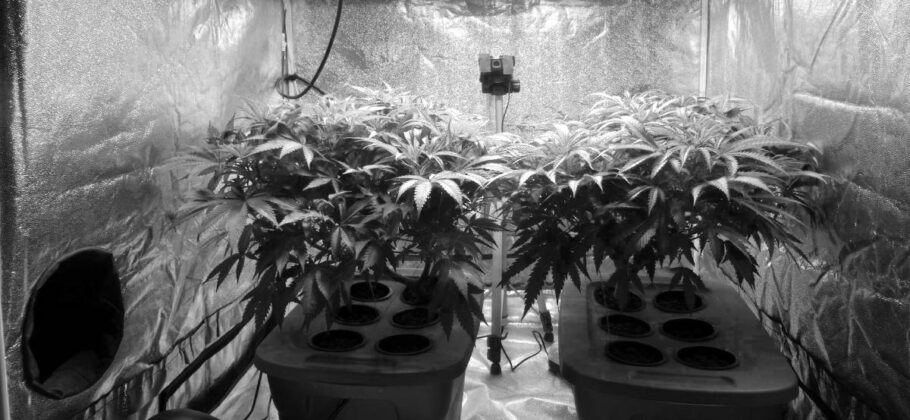
The pattern described is consistent: rural homes bought by out of state buyers, blacked out windows, security cameras, and major power upgrades to support indoor cultivation. The Maine reporting describes 300 or 400 amp electrical service, consumer owned utility poles, and multiple heat pumps running constantly.
This is where electricity becomes a key factor in catching them. Indoor marijuana cultivation requires intense lighting, cooling, and humidity control. That power demand leaves fingerprints. Electricians and utility workers described being asked to install commercial grade service in residential settings, sometimes by clients who do not speak English and watch closely. One linesman described how the overload can be hidden until utilities have to upgrade.
The Maine Wire reported that without robust upgrades, these setups can cause fires, something described at sites in multiple towns.
Violence, coercion, and human trafficking concerns
The story is not only about illegal plants. It is also about the people trapped inside these operations.
Roggeveen said investigators have found large numbers of illegal immigrants who are victims of labor trafficking, living in tents, rundown trailers, and makeshift shacks. He said they often refuse to speak because they fear retaliation against themselves or their families. His assessment was raw: “[The cartels are] treating human beings like trash. It’s horrible.”
Oklahoma’s Woodward described a notorious case that shows how discipline is enforced. He said Chen Wu, allegedly tied to Chinese organized crime, went to an illegal grow site northwest of Oklahoma City to collect $300,000 and opened fire when workers could not pay on the spot. “He shot and killed four people, and shot a fifth person who escaped,” Woodward said. Wu later told authorities he feared being killed by the “mafia” if he returned to Oklahoma, and he was sentenced to life in prison after pleading guilty.
The international dimension: bigger profits outside the U.S.
Roggeveen argues that the trade is built for export and price arbitrage. He said marijuana bought for $450 to $500 a pound or less in California can sell for much more in New York, and in countries where marijuana is illegal and penalties are harsher, he said it sells for “exponentially more,” ranging from $5,000 to $20,000 a pound.
“They’re not growing in the U.S. just to keep it within the United States,” he said. “It’s going international.”
That is why some officials describe this as a transnational business empire, not a local drug ring.
“You have to steal electricity”: how grow houses try to survive
CNN interviewed a Mandarin speaking Chinese national who said he worked in the illegal trade after crossing the Mexican border and finding work through a Chinese language employment pipeline. He described indoor production in a home and said the operation relied on stolen power.
“You have to steal electricity,” he told CNN. “If you don’t steal electricity, the monthly electricity bill will be over $10,000.”
That quote captures the core reality of modern indoor grows. The power demand is so high that it forces criminal choices, either massive and suspicious upgrades or outright theft. Either way, the grid becomes a pressure point for detection.
What officials want: RICO, task forces, and a serious crackdown
Several voices are calling for tougher tools.
Urben urged broader use of the Racketeer Influenced and Corrupt Organizations Act, designed to go after leaders who operate like corporate executives. Roggeveen said the Department of Justice is looking at RICO because it has worked against cartel leaders who see themselves as CEOs of “Fortune 500 style” companies.
Roggeveen also described how federal support can help state and local eradication efforts through funding. But he warned that seizures are still small compared with what exists. “What we’re seizing is not significant to what is actually out there,” he said.
Sen. Susan Collins pressed the Trump administration for what she called a “whole of government” response to shut down illegal grow houses, citing DHS memo claims of hundreds of sites in Maine. “These grow houses are primarily run by Chinese organized crime syndicates with ties to the Chinese Communist Party,” Collins said.
Homeland Security Secretary Kristi Noem responded with a line that shows how seriously some officials view the issue. “This is alarming that we have China,” she said. She then added, “Not only are they stealing our IP, manipulating their currency, but they’re building a presence in this country as well.”
Does it go to the top in Beijing?
This is the claim that hangs over the entire story. Some officials and analysts think it is impossible that Beijing does not know.
Larkin said that because China is heavily surveilled, it is hard to believe the CCP is unaware of criminal activity carried out by Chinese networks abroad. He said enough circumstantial evidence exists to show the CCP is “helping out organized crime.”
But other voices urge caution. In the Politico reporting, Vanda Felbab Brown said the Chinese government has a complicated relationship with organized crime and that there are many unknowns about who is funding and controlling these grows. She warned that experts need to be careful about assumptions.
And again, Wray’s statement matters: the FBI says it sees growing ties to Chinese organized crime but has not publicly found direct links to the Chinese government.
So the most accurate way to frame it using the source material is this: many officials suspect high level awareness or tolerance because of how China operates internally, and they argue the footprint looks too large to be purely rogue activity. But direct proof of top level command has not been presented publicly.
If you listen to the investigators who are closest to the ground, the message is clear. Chinese linked criminal networks have used legalization loopholes, weak penalties, licensing fraud, and modern money movement tools to scale a black market that competes with, and sometimes contaminates, the legal marijuana system.
To critics, it looks like a quiet kind of invasion, not with troops but with cash, shell companies, exploited labor, and infrastructure upgrades that turn ordinary homes into industrial grow sites. To cautious federal officials, it is an organized crime surge with troubling foreign connections that still needs clearer attribution at the government level.
Either way, the warning from the sources is the same: the black market did not die. It got smarter, richer, and harder to uproot, and the networks behind it are no longer just local criminals. They are transnational operators with a footprint that many Americans never expected to see inside their own neighborhoods.